Post: Describe the results of researching your level of access to digital resources. Then answer the following questions:
1. What types of barriers might impede students’ opportunities to access digital learning?
2. What might we do to eliminate such barriers?
Not all students have equal access to the internet and/or to a computer. This is why other areas of the community are so important. Webjunction helps library staff work with other libraries to become a “place of digital inclusion.” This is helpful so that if a student does not have access they can go to their community library and gain access there. Also, not all people have equal digital literacy. Many program throughout the nation seek to target this issue and create a digital literate population.
Standard D: The online teacher promotes student success through clear expectations, prompt responses, and regular feedback.
Standard G: The online teacher demonstrates competencies in creating and implementing assessments in online learning environments in ways that ensure validity and reliability of the instruments and procedures.
Standard H: The online teacher develops and delivers assessments, projects, and assignments that meet standards-based learning goals and assesses learning progress by measuring student achievement of the learning goals.
Standard I: The online teacher demonstrates competency in using data from assessments and other data sources to modify content and to guide student learning.
Answer in a complete paragraph response: How has the Evaluate module prepared you to meet each standard listed above? Link to or provide specific examples from your work in Evaluate. What strategies will you take away from the Evaluate module and apply to your teaching? What lessons were most beneficial for you?
The Evaluate Module helped me prepare for Standard D by working on Evaluate 1 – Quality Feedback. This lesson was helpful because it helped me realize how valuable feedback is and that giving good feedback is just as important. Giving quality criticism can help a student get better and achieve mastery.
The Evaluate Module helped me prepare for Standard G by working on Evaluate 1 – Summative Assessments. This lesson taught me the ways that an assessment must be measured for reliability, validity and security. I realized I can get better at all of these.
The Evaluate Module helped me prepare for Standard H by working on Evaluate 2 – Competencies. This lesson was eye opening. I learned a lot about GaVS and how students can be measured on competencies and learning objectives. My assessments have only ever been grade as a whole, but I realize now that I should be looking at each part of the standard separately.
The Evaluate Module helped me prepare for Standard I by working on Evaluate 3 – Personalized Teaching and Learning. This lesson taught me that the online learning environment can be personalized for students much the same way that a classroom can. An online course can be set up so a student ca go through it at their own pace.
Artifact: Submit evidence of reflection on your individual teaching abilities. Include artifacts, evaluation feedback, your own reflections, e-portfolio links, professional growth plans and anything else that showcases introspection into strengths and weaknesses as an online educator and document all in your individual blog.
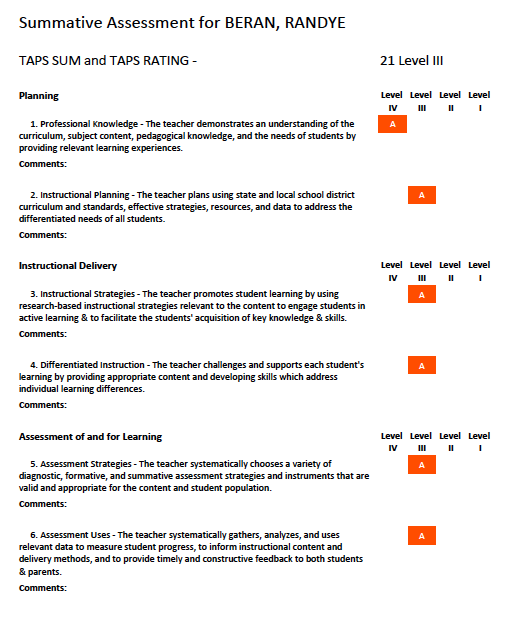
I am not yet an online educator, but below you will see Feedback from 2018-2019 School Year which demonstrates Positive learning Environment, Academically challenging, Use of Instructional Strategies and Assessment Strategies.
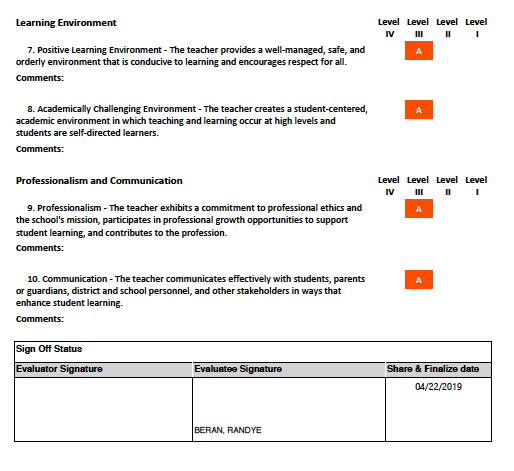
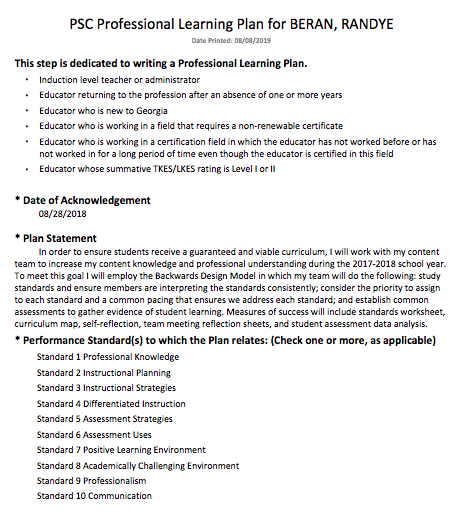
For the 2018-2019 School Year my Professional Learning Plan is as follows:
At the end of the term I ask students to write simple reflections on their experiences from the year: what they learned about math, about the world, about themselves. It’s one of the many ways I get students to write. It’s a great way to model reflection as part of the learning process, and it’s also a good way for me to get feedback about the student experience. Mostly, it’s fun! I love sharing and discussing the reflections with students, and it always results in great end-of-year conversations.
Here are some of my favorites.
After learning a little more about math, I think math is created rather than discovered. This makes mathematicians and scientists the creators, not merely the seekers.
I learned a lot of things from my classmates that I wouldn’t have learned if I were to just study on my own.
I have learned that I still have very much to learn about myself.
Mathematics is magical; it can lead you to a dead end, but then it can miraculously open up an exit.
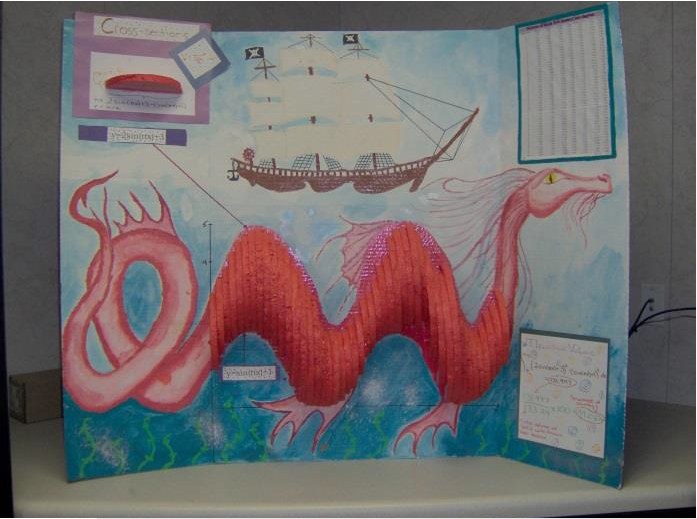
Learning how to think of things in three dimensions completely changed the way I saw math.
By seeing algebraic and geometric interpretations, I learned how to communicate math in more ways.
The process which turns a difficult problem into a relatively easy problem is the beauty of math.
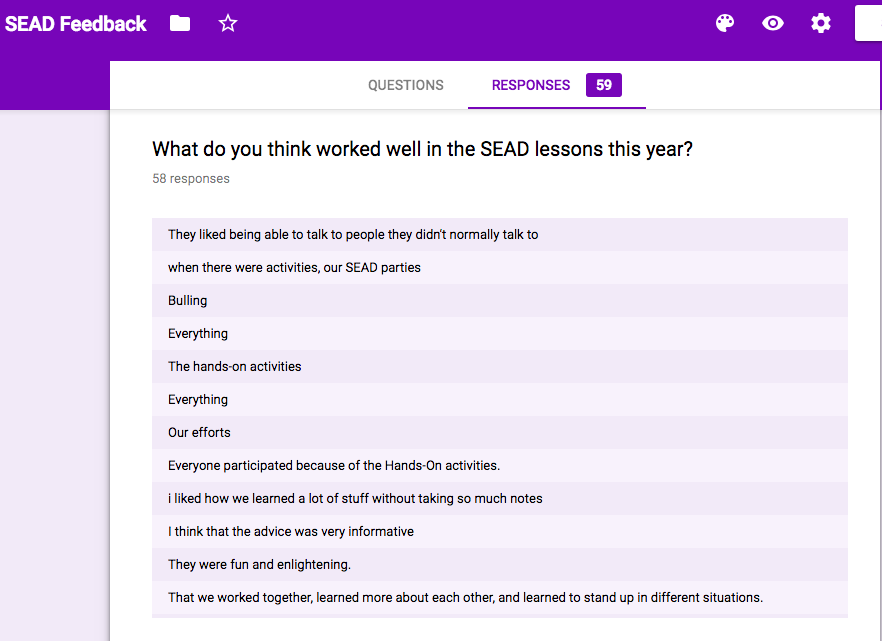
Below is an example of feedback I ask from my students. After introducing a new tool to the class and after every Unit I liked to get feedback from students to see what they liked and what they didn’t like. I like to use Google forms with this type of feedback because it allows me to gauge my students preferences and what tools are useful (either digital or not) and which ones are not.
Create: For this section, set up a competency structure using standards for one unit of your sample course. Associate the assignments in that unit with the competency.
Artifact: Submit both a screenshot of the structure and a detailed explanation of why you created the structure that way. Include a discussion of the various pathways a student may go through to attain the competencies in the unit and document all in your blog.
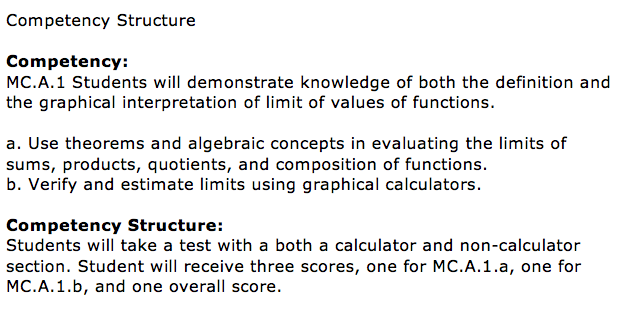
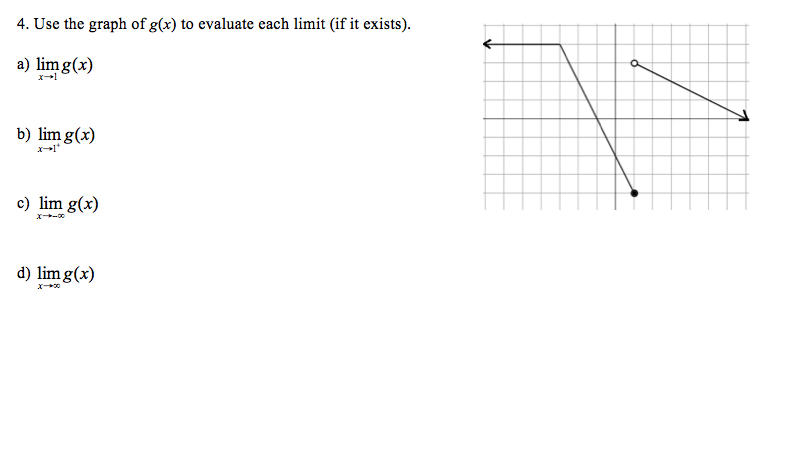
The competency that I chose was MC.A.1: Students will demonstrate knowledge of both the definition and the graphical interpretation of limit of values of functions. In order for students to show they are competent in this standard, students will take a test. WIth this test, there will be three scores, two that address each of the sub-standards, and one overall. This way if a student receives a passing score on one of the sub- standards but not the other, they can remediate one instead of both.
This allows me to see exactly where students are struggling instead of possibly giving a false passing score where they might have done so well on one sub-standard that it covers for failing the other.
Artifact: Provide sample data from student results for a course within your field. The data can be entirely theoretical and written out in text form.
Create: Examine your sample student performance data. Create an action plan that you would implement in your classroom to personalize teaching and learning. Provide both a class and individual approach in your plan.
Answer: How could the data be referenced to identify the needs of each student? How could the settings of the LMS be used to create personalized learning paths? How would this data change your teaching plan? How could it help with remediation or enrichment, etc.?
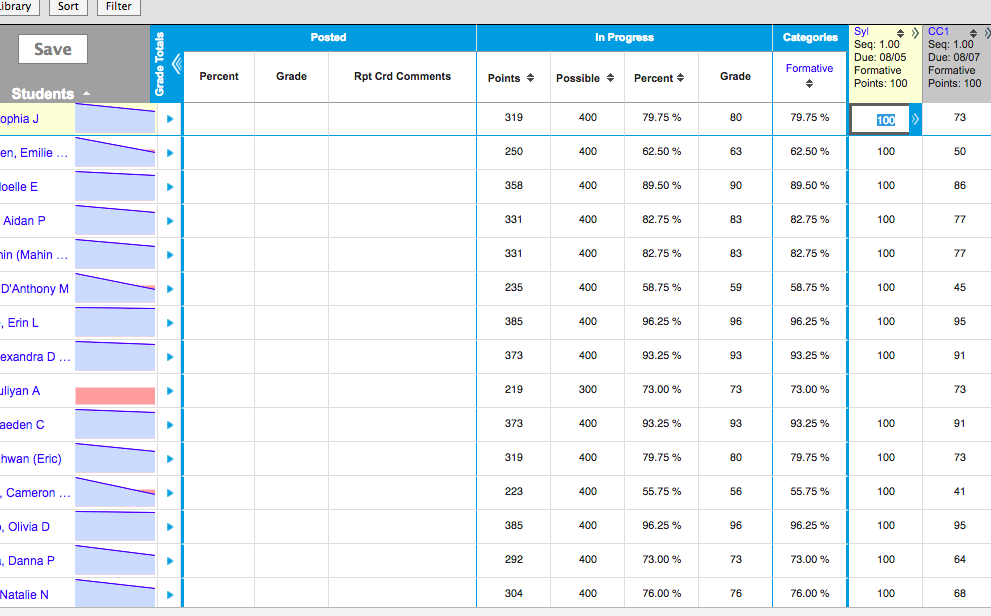
The data for the concept check (column 2) will be used to personalize learning by identifying the students that did not master this standard and have them work on remediation. The cut off will be anyone with a 79 or below will be given a specific remediation assignment based on their need.
Data can be referenced to Id needs of students by analyzing the results and creating a threshold for competency for each assessment/assignment given in the course. With data you can see if a student is progressively getting better or worse in the class, or if there is a specific standard the student is deficient in. You can set an LMS to help with personalized learning by creating something like an IF THEN statement based on data: If you reached this percentage on this assignment you may proceed here, if you attained this you may go here. Understanding where my students are, as far as attainment of knowledge through data, will allow me to ID those who need remediation (to be retaught) or to give enrichment opportunity. Data would/ could and has changed my teaching plan because sometimes you may think your lesson is great, but it didn’t translate well with students.
I have attached the test I gave for Unit 3 in Calculus. It is valid because it measures the students knowledge of this unit clearly, has items to measure each standard and has all levels of difficulty. It has high security because it was created using secure AP questions, there were multiple versions, and I use extreme test security in my class room. This requires no cell phone usage while students are taking the test or while we go over the test afterwards. The results were normally distributed, as they should be, showing the reliability of the exam.
Reflect: Review the artifacts above on student enrollments and student progress in the course.
Answer: How might the teacher adjust the course in the future based on the previous activity of these students? What uses does data have for online instruction? What advantages do teachers who utilize data have over those that do not?
An instructor can adjust a course based on many factors. A teacher can change the course based on data by omitting or changing the lesson that had the least amount of completion. Also, an instructor can look at assessments that had low scores and changes by rephrasing of sentences, or lessons can be better laid out in order for students to retain information. Data gives the teacher concrete evidence of student and class performance; the teacher can see how a student does over time or even look at how students use a particular tool. Teachers who utilize data have many more advantages than those who do not, teachers are able to offer better feedback to students, give students a more personalized learning experience and can become a better teacher.
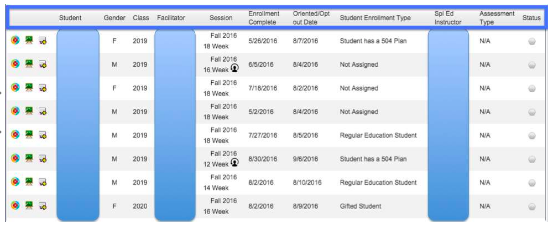
According to the data table both 9th and 10th grade AB Fall classes have low enrollment, while those only in A Fall have a high enrollment. The teacher will have to take into consideration the number of students alone. Those with a high volume of students may end up taking more time i.e. grading assessment and assignments and may prove to be difficult to have collaboration among the students and provide a classroom setting in a digital world. The teacher could try to make more sections of the A Fall courses to help facilitate online collaboration. In this table, the data provides the teacher with the knowledge to provide feedback to administrators who make the sections and provide feedback to create smaller sections. If the teacher uses this chart along with other data showing student completion of assessments, classwork etc. it may persuade administrators to create more courses. Data never lies and helps a teacher provide a better education to students. A smaller course will create a more collaborative classroom environment.
This data tells the teacher what kind of accommodations students have, as well as how long they are enrolled in the course. The teacher can see the data of all 12 week, 14 week, 16 week and 18 week long enrolled students and see if assignments are completed among these groups of students. There may be a difference in how an assignment is completed and the teacher can then make adjustments to any assignments to better differentiate. The teacher should then separate the data of students who have accommodations and see if they completed assignments. If those students were not able to complete the assignment to expectations perhaps the teacher needs to look at delivery and other methods to help those students achieve the expectations of assignments. Teachers that use data, like this chart have an advantage over others that don’t because they will be able to better accommodate all students and make their learning experience better.
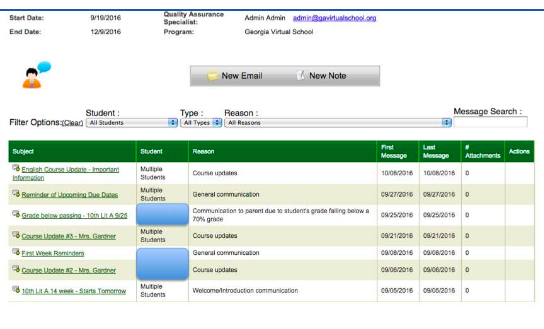
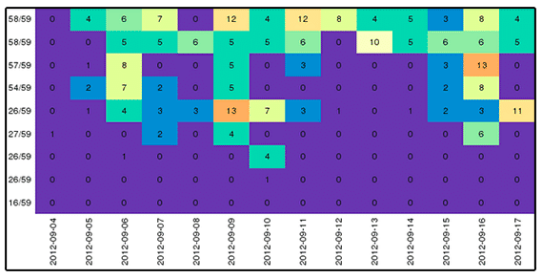
This data shows a teacher how to adjust a course by looking back and through communication and seeing if the student passed the course. If the teacher sees a correlation between not passing/barely passing and the first communication, the teacher can adjust the timing of the first communication of grade below 70%. According to the table the class began on 9/5 and communication of course failure was 20 days afterwards. (3 weeks in). If the teacher finds a correlation between this communication and failure rates of those same students the teacher should adjust first communication as soon as the student falls before 70% or is showing a trend/pattern of failure. When teachers use data like the above chart to guide instruction, they have distinct advantage over teachers who do not because they are able to make their teaching and communication better, which can then lead to higher pass rate (more learning) in the course(s).
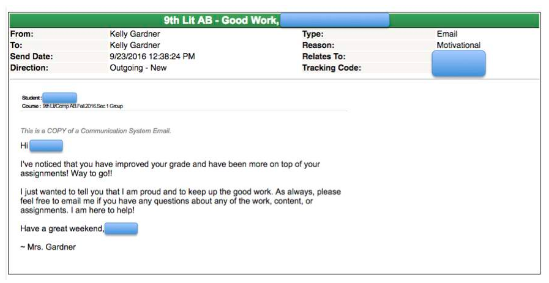
This is a motivational email to a student that perhaps was failing in the course but is now doing a good job. This is a great tool to say to a student I see your hard work and keep it up.The teacher will be able to see a direct correlation between motivational email communication and passing the course. Teachers who utilize data to drive instruction have a distinct advantage over those who do not because they can make changes to their course and communication in order to increase student achievement.
This chart gives information on how many assignments students have completed and how many tools they have used for a particular assignment. The teacher can use this data for future course by seeing how many tools were used and which ones were not. For example, For the first assignment, the tool(s) provided were not used at all. This data would tell the teacher to re-evaluate the assignment and the tool(s); are the tools useful to the assignment? Do the students need to use the tool? The teacher can also see the correlation between the grade on an assignment and tool usage; if a student can do well with out using a tool, then the tool is not useful and teacher needs to reevaluate both the assignment and tools. This data is very useful in online instruction because the teacher can have an up to date understanding why a student is doing well or not doing well in the course; the teacher would be able to provide proper feedback to each student based on this data. A teacher who uses this data has a distinct advantage over teachers who do not because they will be able to communicate better with parents and students, as well as make changes to assignment and tools to make the course better.
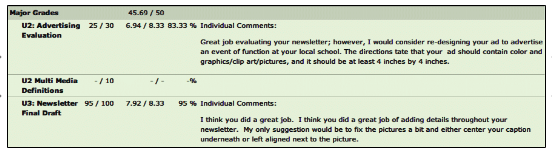
The teacher would need to look at all the feedback given to students. For example, for U3 Newsletter Final Draft, the teacher comments on what was missing for the newsletter ( Center captions and left align pictures). It would be necessary for the teacher to look at all feedback because if there are many students who did the same thing than the teacher missed a lesson on showing that skill or needs to improve the delivery of the lesson that teaches students that skill, perhaps even give them a small formative to show they are able to do it correctly. This data is useful in online instruction for several reasons, the first is that it provides students a way to see feedback from the teacher and how to improve on future assignments. The second this allows the teacher to collect all feedback given to students and see if there are any correlations, or skills that all/ most students missed. If so, then the teacher can make improvements on the lesson. A teacher who uses this data has a distinct advantage over teachers who do not because they will be able to see where students have gotten the skill and where they have not, this will allow the teacher to adjust lessons for future students.
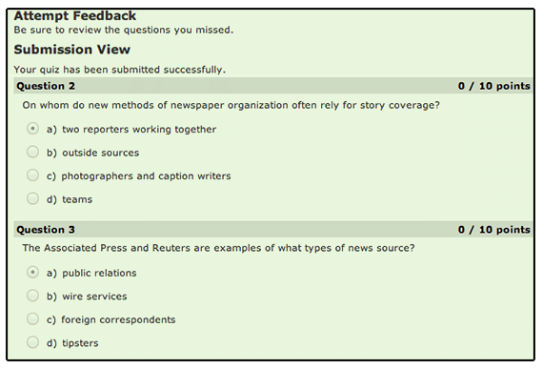
The data above shows the questions missed by a particular student. However, it does not show any links or tools to help students know which one is the correct answer. The teacher can make improvements based on this data by looking at all students and seeing which questions were commonly missed within a certain threshold. If there are common questions missed then the teacher needs to look back at the lessons in which the standard is covered and redesign the lesson so that students can obtain the knowledge necessary. Also, I wonder if students are able to retake quizzes as a way to facilitate Growth Mindset and the concept of Try Again. This data is useful for online instruction because it allows the teacher to see which students are passing quizzes and which are not, what concepts are being learned and which ones are not. This data will allow the teacher to come up with a reteaching moment (Review) for those students who did not get the concepts the first time around. A teacher who uses this data has a distinct advantage over teachers who do not because they will be able to help students reach their learning goals better. Using the data above will also allow students to know which learning goals they have reached and which ones they have missed.
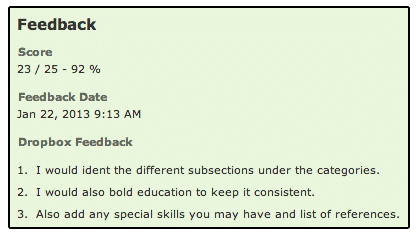
This student was able to get full credit for the cover letter but missed a few points on the resume portion because of aesthetics and missing portions (skills and references) The teacher can see how many students made the same mistake; if there were many students with the same mistakes the teacher should re-evaluate the lessons leading up this and even the rubric so that students know what the expectations are. Also, I am wondering if the teacher allows the student to fix what they missed and receive a portion of the points back as, learning how to create a good resume is the goal here. This data is useful in driving instruction because the teacher may see that students missed the same requirements and this would prove to be a re-teachable moment for the students. Teachers who use this data have a distinct advantage over those who don’t because this data gives great student feedback which allows them to take control of their learning. With the feedback given students understand where they went right and where they went wrong. Teachers can also use the feedback of all the students to see if there is any correlation between tasks missed between all of them and re-evaluate the lesson/rubric and other tools that go with the assignment.
Create: In your blog, provide or create a student work sample and accompanying feedback that showcases some of the expectations listed below and offers a sound example of quality, authentic feedback. In particular, your feedback should demonstrate the bulleted items below. Instructor clearly strives to assist all students in meeting and exceeding expectations and considers feedback as the cornerstone of that success.
Encouraging, customized feedback which propels the student to strive for better performance or for deeper thought and application.
Student data drives the feedback provided as individual feedback, as well as the class as a whole.
Teacher is not only assessing current progress on individual items, but is also analyzing each student’s continuous progress from grade item to grade item.
Instructor clearly strives to assist all students in meeting and exceeding expectations and considers feedback as the cornerstone of that success.
Artifact: Provide a student work sample and accompanying feedback.
Answer: Why is it important for an instructor to consider student performance data when providing feedback? How can feedback be both observational and instructional?
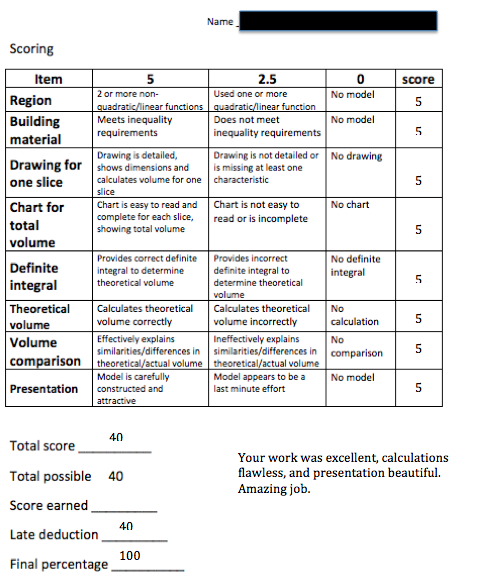
It is extremely important to include student performance data when providing feedback because it adds support to your feedback. For example, in my student feedback I mentioned to the student that she had done a great job with perfect calculations. Feedback can be both observational and instructional by including what you have noticed during class time.
Reflect: Consider the best means of developing and delivering assessments, projects, and assignments that meet standards-based learning goals and assess learning progress by measuring student achievement of learning goals.
Answer: How might a teacher employ ways to formatively assess student readiness for course content and method of delivery?
Artifact: To demonstrate this, create a formative assessment related to a learning standard. Post a link to the assessment or activity in your blog. Explain.
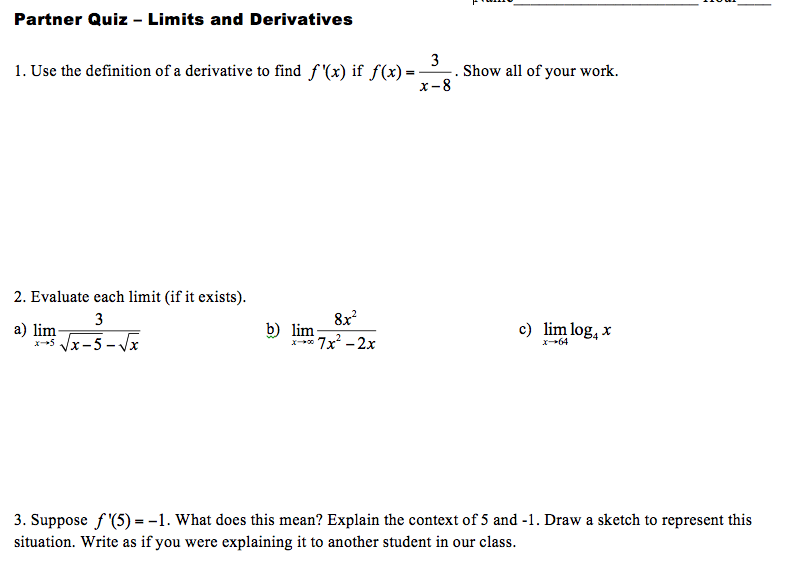
Students will work with a partner to complete this assessment. In order to show mastery, they need to they can find a limit and use the definition of a limit to take a derivative. This will tell me if students are ready to move onto the next unit, derivatives, which will make the connection with the definition of the limit. I will also know with this who needs remediation before a summative assessment.
Standard C: The online teacher plans, designs, and incorporates strategies to encourage active learning, application, interaction, participation, and collaboration in the online environment.
Standard D: The online teacher promotes student success through clear expectations, prompt responses, and regular feedback.
Standard E: The online teacher models, guides, and encourages legal, ethical, and safe behavior related to technology use.
Standard J: The online teacher interacts in a professional, effective manner with colleagues, parents, and other members of the community to support students’ success.
Standard K: The online teacher arranges media and content to help students and teachers transfer knowledge most effectively in the online environment.
Answer in a complete paragraph response: How has the Communicate module prepared you to meet each standard listed above? Link to or provide specific examples from your work in Communicate. What strategies will you take away from the Communicate module and apply to your teaching? What lessons were most beneficial for you??
The Communicate Module helped me prepare for Standard C by working on Communicate 2 – Synchronous Sessions. This assignment helped me think about how I could possibly take some of my in class assignments and translate them to online or digital assignments. The tools I was able to explore will help me with synchronous sessions in the future.
The Communicate Module helped me prepare for Standard D by working on Communicate 3 – Digital Feedback. This assignment helped me to think about various ways to provide digital feedback to students, as I will not get to see them on a day to day basis.
The Communicate Module helped me prepare for Standard E by working on Communicate 1 – Communication Laws. This assignment helped me to better understand the rules that govern the way I should practice teaching with online use. This will help me be a model digital citizen.
The Communicate Module helped me prepare for Standard J by working on Communicate 2 – Ongoing Communication. This assignment helped me to understand the need to communicate with all stakeholders, and to make sure not to neglect any party.
The Communicate Module helped me prepare for Standard K by working on Communicate 2 – Synchronous Sessions. This assignment also helped with this standard as it allowed me to see the platforms in which synchronous learning can occur. This lesson was by far the most helpful in this module as I was able to explore synchronous learning.


 Dr. Beran's Educational Blog